


#HeritageForTheClimate
#HeritageForTheClimate is a motto which is going to accompany us – the employees of TRAKT Cultural Tourism Centre – throughout the whole 2020. The discussion about the choice of this theme lasted several months. Not because we were not convinced of the importance of the subject. It was rather a question of a dilemma over whether a cultural institution, whose statutory area of activity focuses on local cultural heritage, can, in fact, have a say in the discussion on the global climate change. The discussion which seems to be reserved for scientists, politicians, entrepreneurs or, when it comes to our industry, nature and natural history museums and science centres.
Relatively quickly, however, the initial hesitation turned into a strong conviction that not only we can or should engage in the process of supporting mitigating and adaptative action relating to the global warming, but it is, in fact, our duty. It is our ethical obligation resulting from the social responsibility of a cultural institution to take care of the heritage entrusted to it. We are also obliged to do it by the unique environment in which we work. Porta Posnania, which is our main exhibition and education space, is located by the Cybina River. Close proximity to the river, which is disappearing right in front of our eyes, as well as to the drying riverside meadows leaves no doubt that the centuries-old heritage of this place is ENDANGERED. How are we going to be able to talk about the island on which Mieszko i established a fortified settlement, built a magnificent palace and founded the first cathedral in Poland if it disappears from our landscape? How are we going to explain such dramatic changes in our surrounding to the next generations?
In order to develop the idea of #HeritageForTheClimate effectively we joined the Climate Heritage Network (CHN) created at the International Council on Monuments and Sites (ICOMOS). We share the belief that art, culture and cultural heritage are a great asset and have the power to inspire and initiate action to combat climate change. They have the potential to contribute to creating sustainable development pathways. This potential, however, still remains untapped.
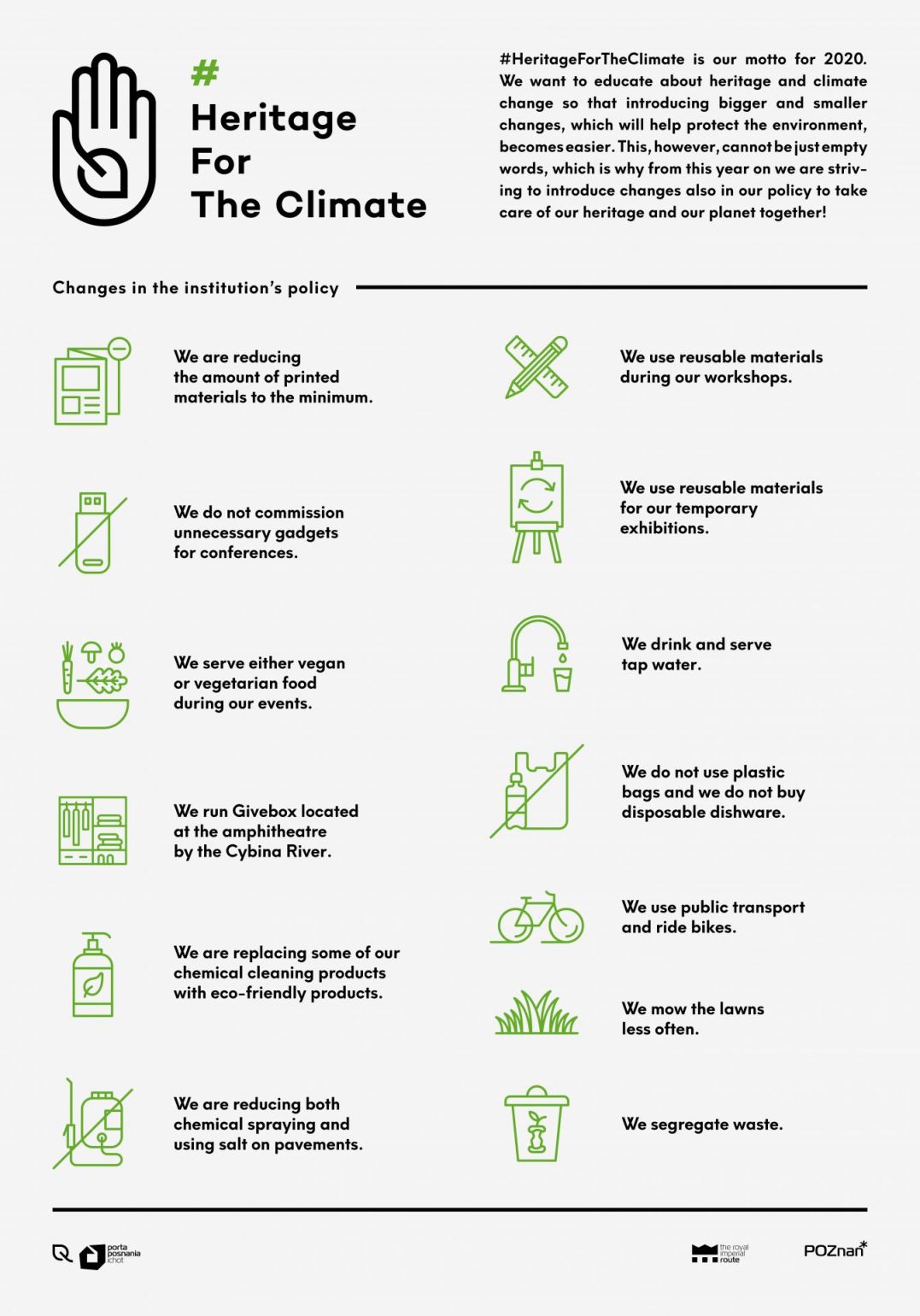
The plan of action, which has been adopted to implement #HeritageForTheClimate’s postulates, is twofold. The gist of the plan is presented in our manifesto. First of all, we acknowledge that an effective way to shape pro-environmental behaviours is to set an example. Thus, we created TRAKT’s ‘green code’, which we share with you on the next pages of this publication, along with the aforementioned manifesto. We consider these changes in our internal policy as a permanent process of self-improvement. Secondly, drawing on our knowledge, passion, space and resources, we have planned a year-long programme of educational and tourist events and exhibitions.
The majority of our #HeritageForTheClimate initiatives will take place as soon as it becomes possible. When that happens we will invite you to join us at Porta Posnania, at the Royal-Imperial Route, in the district of Jeżyce, Łazarz and Wilda as well as at the Poznań Legends Route for Children.
Monika Herkt, Director of TRAKT CTC
Manifesto
Just like a tree is born out of the ground, cultural heritage is born out of natural heritage. One is connected to the other, like oxygen is connected to the air, the air to breath, and breath to life. In other words, culture does not exist without nature, just like the human being is inextricably connected to water, plants, the air and the ground. Their relationship is interdependent. In terms of the current climate crisis, our motto Heritage for the climate refers to the necessary and morally indispensable priority which defines the direction in which every cultural institution’s action should go. The word ‘heritage’ refers to cultural and natural values. Caring about nature is tantamount to caring about all other resources. Especially when their future is uncertain, to say the least. The list of endangered species comprises millions of plants and animals, including the human being.
Awareness of the climate crisis obliges us to engage in deep reflection on individual choices and actions taken by a cultural institution. Fostering the anthropocentric illusion which allows us to create more and more cultural products without making sure whether or not they take into account our (impossible to reject) reliance on nature is both short-sighted and immoral.
In 2020 TRAKT Cultural Tourism Centre is taking action focused on the broadly defined climate protection. Lectures, workshops, performances, outdoor activities, exhibitions and other events will, first and foremost, touch the issue of ecology – heritage for the climate. Ecological crisis is an opportunity for us to wake up from the illusion and our egoistic desire to possess and consume. Awareness of the feebleness of the endangered heritage and respect for it no longer allow us to take action focusing on enhancing our own image and deriving pleasure instead of providing benefit for the Earth and all its inhabitants.
Robert Rient*
DZIKHI BIT
This issue of DZIKHI BIT as well as the programme of events planned for 2020 by TRAKT CTC had been prepared before the pandemic reached us. Although the situation has changed and the possibility to implement many of our plans is now limited, we decided not to change the subject of this publication because the themes we are discussing in it will still be important after the fight against the virus has ended. The pandemic made us realise the fact that we have to take even more responsibility for the world.

*Robert Rient – a journalist and writer born in Szklarska Poręba; author of the reportage titled Witness published also in the US, as well of the novels Duchy Jeremiego (Jeremy’s demons) and Przebłysk. Dookoła świata – dookoła siebie (Flash. Around the world – around oneself). He cooperates with the magazines Sens and Przekrój – in the latter, he is the author of the cycles titled Istoty rzadziej spotykane (Rarely encountered creatures), Ludzie listy piszą (People write letters) and the latest one titled Wizje roślin (Vision of plants).
The project is financed by European Funds for Regional Development as part of 6.4 Innovative Economy Programme 2007-2013.

